The Creative Process #48 - Elemental Joke
What's the iron core of your creative endeavours?

Occasionally it's beneficial to step outside of the news and the current timeline, and go seek some wisdom somewhere else. Books are the obvious go-to, but I do enjoy plunging into the back catalogue of podcasts. Back in simpler times, or weirder times like COVID.
One of the gems borne from COVID quarantine was Ben Folds' Lightning Bugs podcast, where he interviewed various creative or scientific people about creativity and their process. This particular episode I caught recently was with the comedian Margaret Cho. I never really dug into her work, but she's quite insightful about the creative process and observant of her fellow comedians.
She spoke about how every stand-up comedian has one elemental joke in them; a crystal of truth that they build many of their jokes around, often for their whole career. Her elemental joke is:
I'm not supposed to be here, but I am.
She found a way to frame her experiences with being Korean-American, being a woman, being gay, being feminist, all around this core friction. She had a number of other examples that she felt applied:
- Joan Rivers: "Can we talk?" being the call to strip away all the artifice of society and get down to the brass tacks.
- Jerry Seinfeld: "Is it me, or is society saying this all wrong?" as the purest form of observational comedy.
- Dave Chappelle: "You can't tell me what I can't say", which was perfectly exemplified in the finale of his latest Netflix special.
I feel that this elemental core is essential for performing arts – you are the persona up on stage and you have to present a central thesis even if the audience isn't aware of it.
I've been thinking about this for other kinds of art, including my own. I have a running joke with friend of the newsletter Mike from Armiger Games who makes a wide variety of tabletop games:
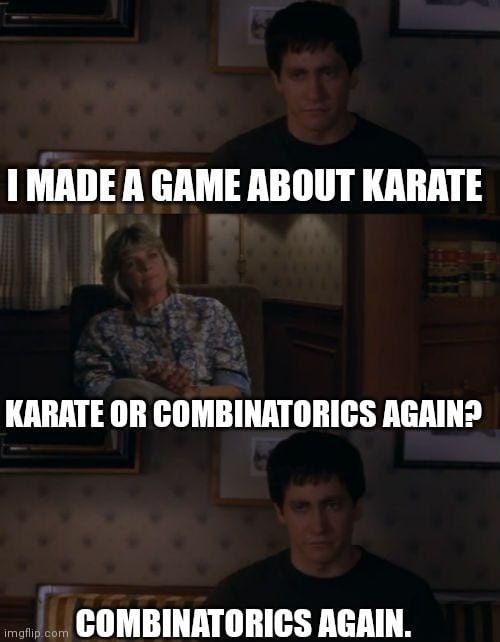
The core truth here is that he's an absolute master at using sophisticated combinatorial designs to construct effective game mechanics. I don't think it was an intentional approach – he's a mathematician and was going through a period of rapid game development, so you use what you know. The process honed it to a razor's edge!
When you get closer to writing, I feel like it gets harder to pin this elemental form down. Someone like Terry Pratchett highlights the absurdity and truth in real life by transplanting it into fantasy. This isn't too far from the normal approach of science fiction of exploring modern ideas through futuristic lenses, but Terry was a master at distilling the satire down to a potent and palatable brew.
Interactive fiction I struggle to find many good examples. People write in genres or styles, but that's not the same thing. Maybe the closest I can find is Andrew Schulz's oeuvre of puzzle-based parser games around wordplay. They say something about the intersection of interactivity and the words you use, but I'm unsure if he has a central thesis. Emily Short's works are as much academic experiments as works of art, but I similarly can't see the core friction of Emily-Short-the-person rather than Emily-Short-the-assemblage-of-ideas. Porpentine is probably the correct answer here, but I have not played enough (any?) of their works.
Turning inwards, as one must, I'm unsure what my elemental truth is. Perhaps it's "don't do the obvious thing". I wrote a chaotic neutral RPG campaign that was an inverted dungeon crawl (the universe was the dungeon). I had another which was "superheroes and villains in a fantasy city" but the players weren't either of them. Anne of Green Cables was a cyberpunk pastoral mashup attempting to not abandon either side of that coin. Cart was the perspective but not the voice of the lowest of society.
Comedians use their elemental joke to catalyse material around. This guess at mine doesn't do that so well. It's like when I was renting a house that had two similar house keys, but only one unlocked the front door. My mnemonic for which key it was: "It's not the one you'd expect it to be" which is utterly insane and impractical. Similarly "don't do the obvious thing" is really only effective if you are proficient enough with the obvious thing to risk doing the non-obvious.
My IF Study Course continues on. I'm finding it tricky to do both the slow play and the exercises in the month, and that's even after adjusting them to be easier to complete. I did enjoy the writing exercise this month: Retheme the main characters from a popular series. I did "Pride and Pizza", transplanting the Teenage Mutant Ninja Turtles into Jane Austen. It even kinda worked and could Become A Thing, although I'm gun-shy after a similar trick with Anne of Green Cables.
I have to find a game for the next set of exercises. I've done two IF Comp winners in a row, and need something different. I stumbled across Violet, a renowned parser game, although it too had won IF Comp. There are some seminal Choice of Games pieces that have been suggested to me. If you have any suggestions, especially ones you think I could/should learn from, let me know in the comments.
I've signed up to help out with IF Comp this year, which should be fun. I feel the siren song of another few weeks off to do creative work, but maybe I could let that coincide with the IF Comp judging period.
I hope you're all having fun creating or completing or just enjoying.